
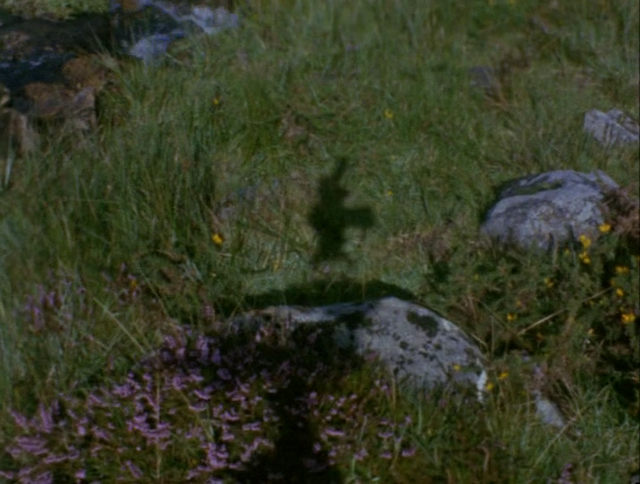
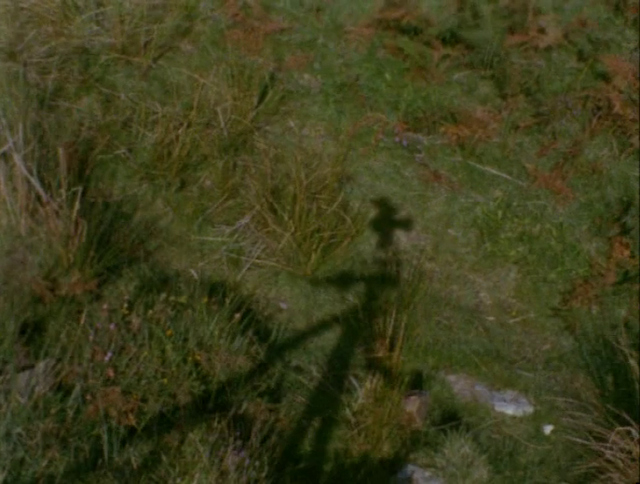
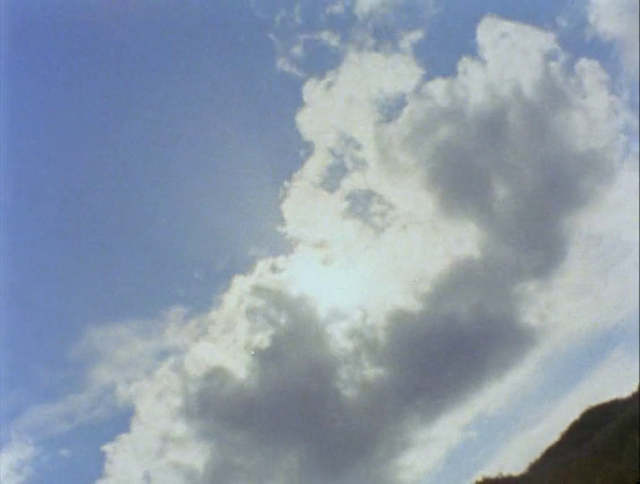
One frame was taken every ten seconds throughout the hours of daylight. The camera was mounted on an equatorial stand, which is a piece of equipment used by astronomers to track the stars. In order to remain stationary in relation to the star field, the mounting is aligned with the Earth’s axis and rotates about its own axis once every 24 hours. Rotating at the same speed as the Earth, the camera is always pointing at the either its own shadow or the sun. Selection of image, (sky or Earth; sun or shadow), was controlled by the extent of cloud coverage, i.e. whether the sun was in or out. If the sun was out, the camera was turned towards its own shadow; if it was in, the camera was turned towards the sun. A directional microphone was used to sample sound every two hours. These samples were later cut to correspond, both in space and time, with the image on the screen.
In Seven Days the in camera-editing is governed by the passing clouds and the shape of the film is therefore, not imposed on nature but emerges spontaneously from the collaboration between the film-maker, the rotation of the planet and seven days worth of stormy, unpredictable weather.
Seven Days (Chris Welsby).mkv

General
Container:  	Matroska
Runtime: 	17 min 37 s
Size: 	264 MiB
Video
Codec: 	x264
Resolution: 	714x576 ~> 768x576
Aspect ratio:  	4:3
Frame rate: 	25.000 fps
Bit rate: 	1 900 kb/s
BPP: 	0.185
Audio
#1:  	English 2.0ch AC-3 @ 192 kb/s (Stereo)
https://nitro.download/view/8AB4B2F40D404B4/Seven_Days_(Chris_Welsby).mkv
Language(s):English
Subtitles:None